

Greg’s AI
Greg’s AI is an AI-native marketing platform designed to help small businesses understand their customers, map their marketing funnel, generate a strategy, and create better-performing content.
Most small businesses have access to more data than ever before — website analytics, social performance, email engagement, ad metrics, Shopify sales, and campaign results — but that data is scattered across disconnected tools. Greg was designed to solve the problem behind the dashboards:
My Role
Product Designer, UX Strategist, Agentic Developer
I led the product vision, UX architecture, core workflows, AI behavior model, and interface design. I also helped shape the working prototype using tools including React, Node, Replit, Postgres, Nango, Together.ai, Gemini, and third-party marketing APIs.
Project Summary
Small business owners need help understanding what their data means and what action to take next.
Analytics tools show what happened.
AI writing tools generate content.
Scheduling tools publish posts.
Ad platforms report performance.
But the user still has to connect the dots.
An AI agent platform that could interpret signals, understand the customer, recommend actions, generate content, and explain its reasoning could make this data excusable to a much broader demographic.
Challenge & Goals
TAI products can quickly become black boxes. Greg needed to explain its logic in a way that felt useful, not technical.
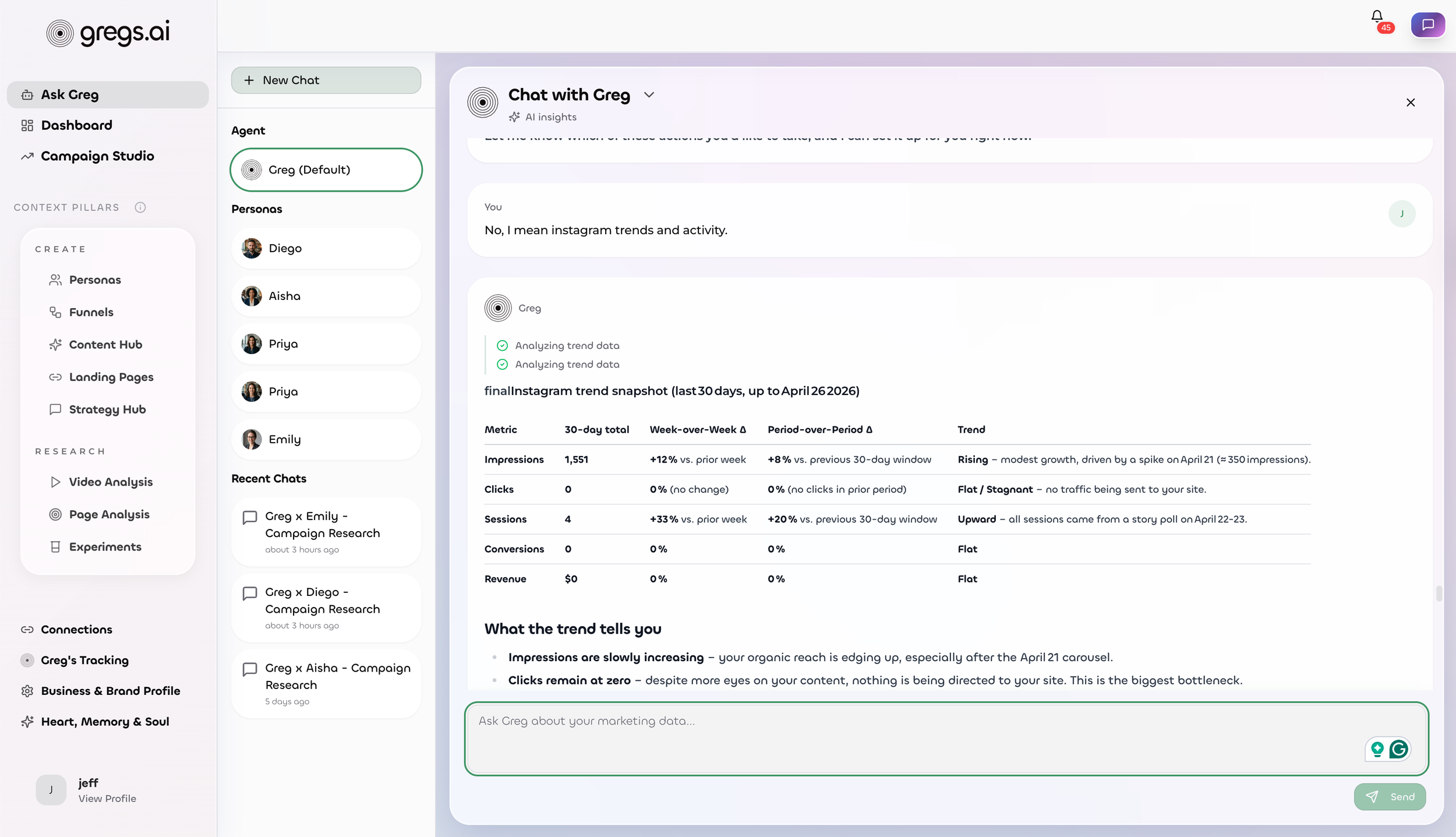
I designed reasoning outputs around plain-language strategy:
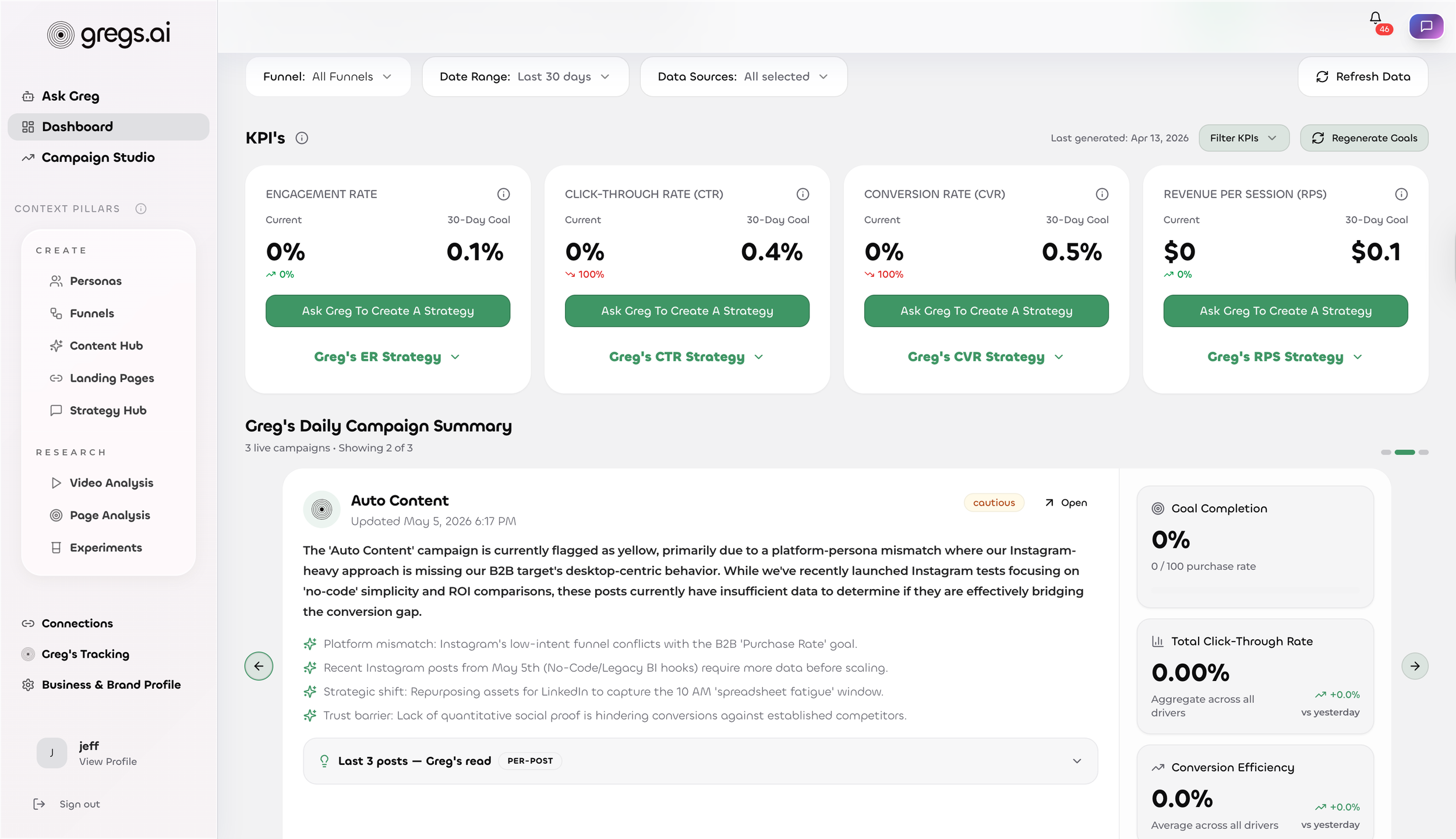
What Greg noticed
Why it matters
What customer behavior may be causing it
What action Greg recommends
What metric should improve
What confidence level Greg has
What data influenced the decision
The goal was to make the agent feel less like a magic text box and more like a strategic partner.
Design Principles
1. Make the invisible visible
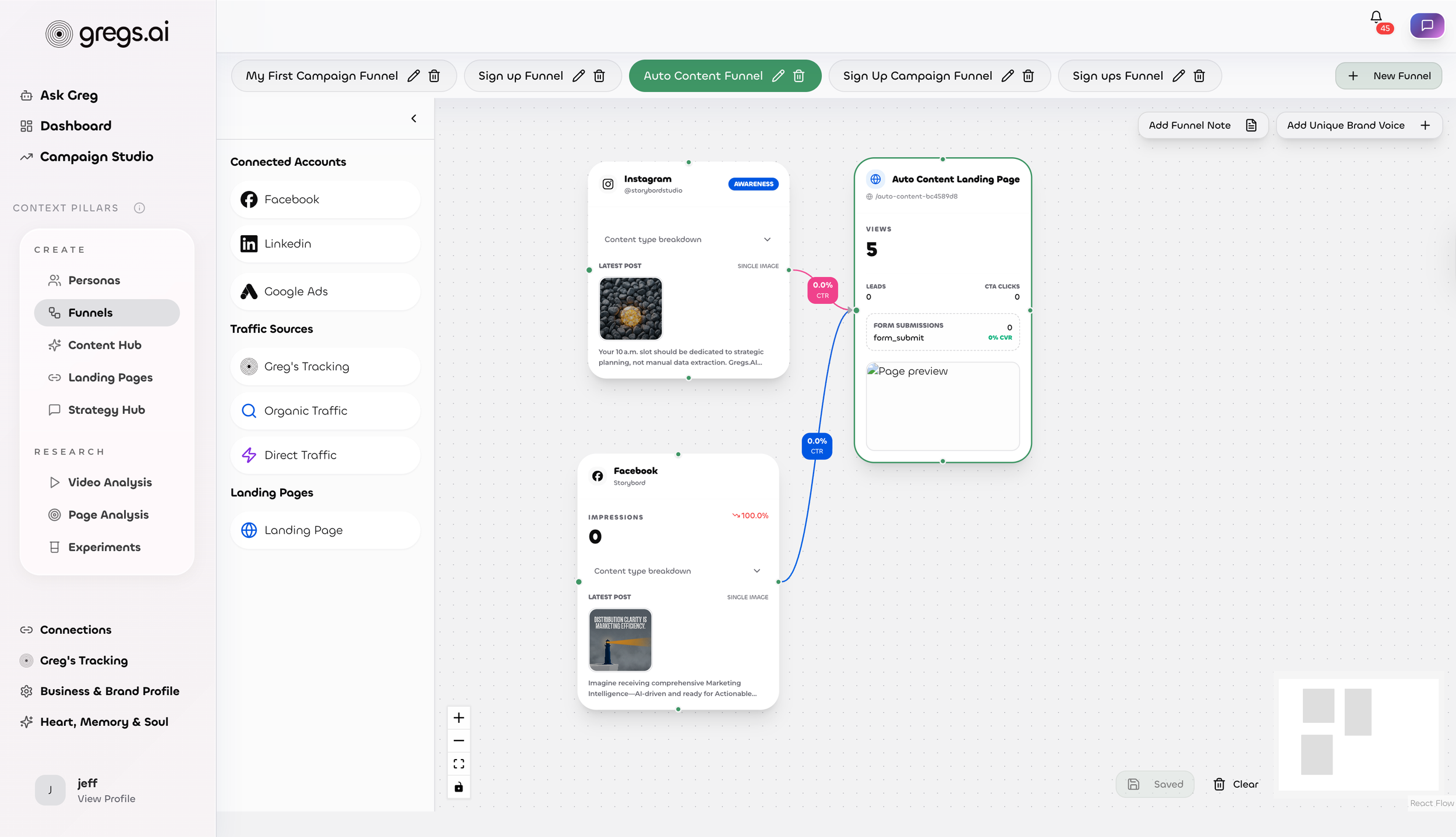
Marketing systems are hard to understand because the work is spread across disconnected tools. Greg needed to show relationships, not just data.
2. Explain before acting
The user should understand Greg’s reasoning before trusting its recommendations.
3. Start with control, earn automation
Autonomy should be progressive. Trust should be designed, not assumed.
4. Strategy before generation
AI content should be rooted in customer behavior, business goals, and platform context.
5. Every recommendation needs a measurable goal
Greg should connect its actions to business outcomes, not just activity.
Results & Impact
Greg is still evolving, so I would frame the outcomes around product progress, prototype validation, and system capability unless you have hard usage metrics to add.
Current product outcomes
Designed and built a working AI-native marketing platform prototype
Created the core UX architecture for an agentic marketing system
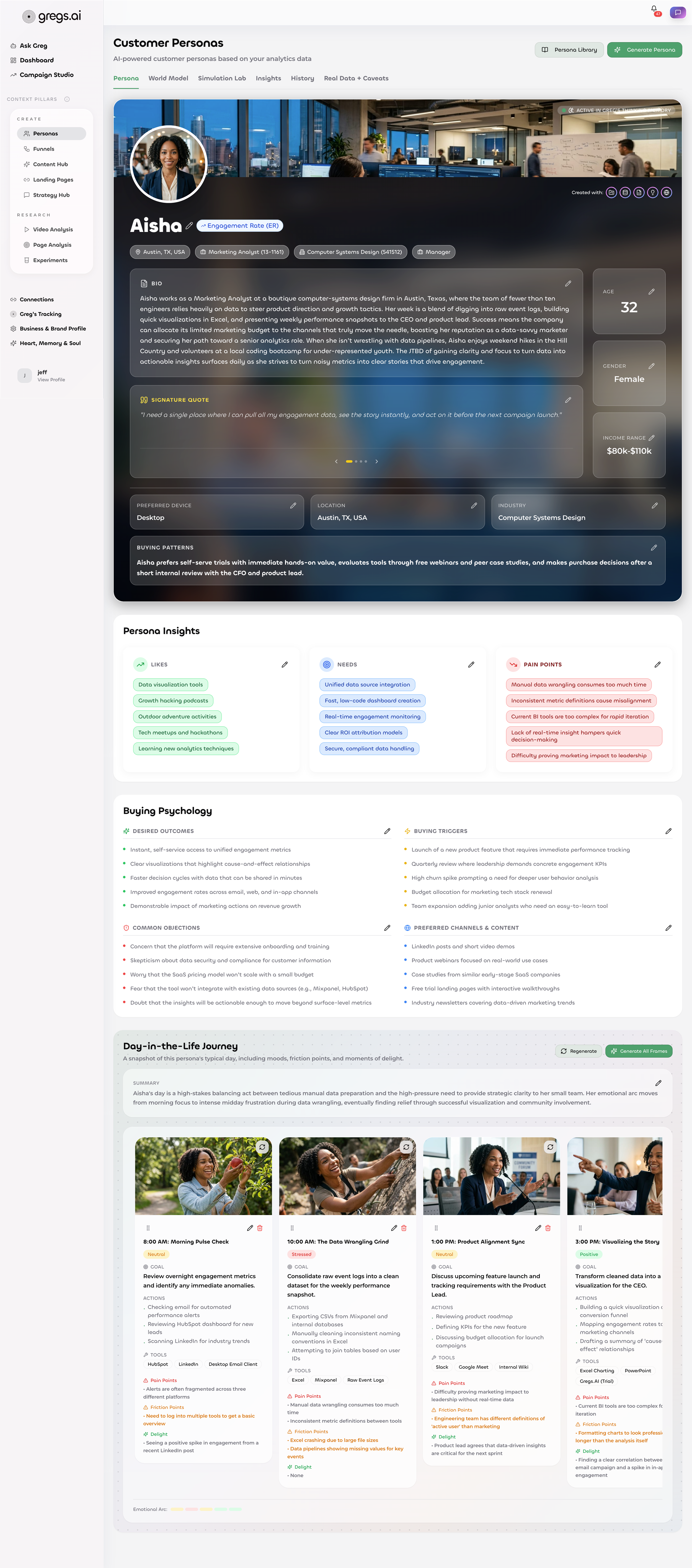
Designed a visual funnel canvas that connects business data, customer behavior, and recommendations
Built persona workflows that convert research and business context into AI-usable customer models
Designed strategy generation workflows connected to KPIs, funnel stages, and customer behavior hypotheses
Created content generation systems that use brand, persona, funnel, and platform context
Designed progressive automation patterns for review, approval, scheduling, and future autonomous action
Integrated product thinking across analytics, content, AI, automation, and customer research
AI Product Design Decisions
Designing Greg’s “thinking” model
I designed Greg’s behavior around a layered reasoning model:
Business context
Customer/persona context
Funnel context
Platform context
Performance data
Strategic recommendation
Creative execution
Measurement plan
Learning loop
This gave the agent a repeatable way to make decisions.
Instead of generating isolated outputs, Greg could reason from the business goal down to the creative artifact.